From Image to Experience: Lessons from DATALAND for Iranian Events

Los Angeles’ DATALAND uses 84 4K laser projectors, live data, and multisensory design to redefine the boundaries between art, technology, and storytelling. The project offers Iranian brands and event organizers valuable lessons in experience design, engagement, and the purposeful use of emerging display technologies.
At many events, a large display, LED wall, or animated visual is used simply to attract attention. Successful experiences, however, emerge when technology serves a clear narrative. Audiences should not merely see a larger image; they should feel that they have entered a story, influenced it, and encountered something memorable.
DATALAND, the Los Angeles museum of AI art, is a notable example of this approach. Founded by artist Refik Anadol and Efsun Erkilic of Refik Anadol Studio, the museum opened in June and has transformed its Data Pavilion into a multidimensional environment through powerful projection, live data, and sensory design.
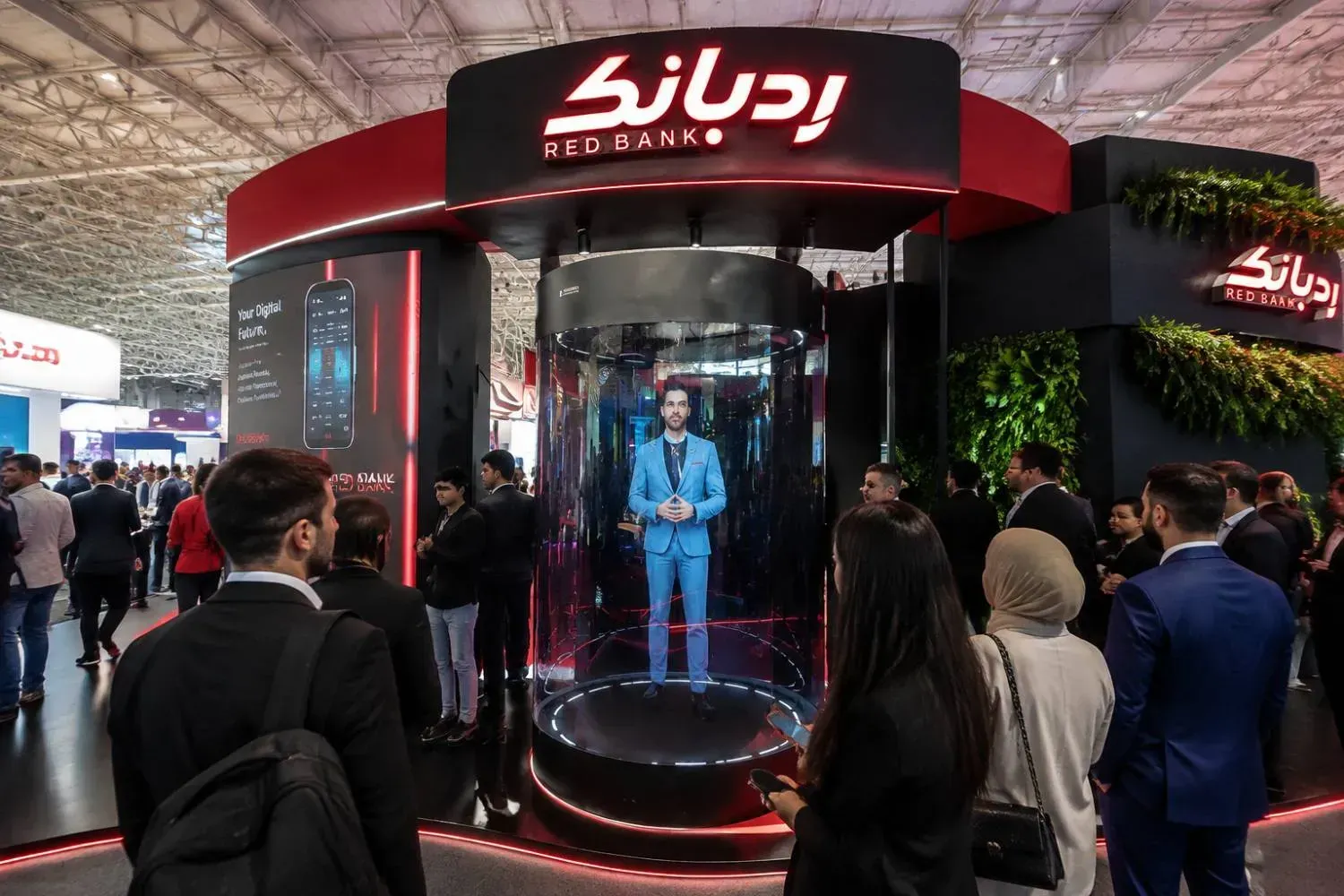
For marketing leaders, Iranian brands, and exhibition organizers, the importance of this project lies not only in the number of projectors or the scale of the venue. Its real value lies in the way it connects technology, architecture, content, and audience behavior—an approach that can be applied to booth design, product launches, brand museums, industrial exhibitions, and corporate events.
How did DATALAND turn an exhibition space into a living narrative?
DATALAND occupies 25,000 square feet across five galleries. Its largest section, Gallery A, has been transformed through projection into an immersive, constantly changing environment in which images are not confined to a fixed surface. Walls, columns, and ceilings all become part of the work’s canvas.
The museum’s inaugural exhibition, “Machine Dreams: Rainforest,” takes visitors on an immersive journey through five galleries. The works draw on live data from 16 locations in rainforests and seek to create a deeper connection between audiences, nature, and its inherent intelligence.
This point is highly relevant to commercial events: data gains communicative value when it is presented through an understandable story. An energy brand, for example, could turn consumption or production data into a visual landscape; a logistics company could present the movement of goods as a dynamic narrative; and a tourism brand could transform destination information into a spatial, interactive experience. In every case, technology should help answer one question: what should the audience understand or feel after leaving?
Technical scale: when projection becomes part of the architecture
The project uses 84 large-scale Epson projectors with 4K resolution. The selected model, the EB-PQ2220B, is a laser projector with 20,000 lumens of brightness. Together, the systems produce nearly 700 million pixels and more than 1.5 million lumens of brightness, enabling the projection of imagery across tall walls and expansive surfaces.
Yet the central technical consideration is not output power alone. Refik Anadol Studio worked with Epson from the design stage to study how the imagery would interact with mirrored ceilings, reflective columns, and a mirrored entrance. In such an environment, inaccurate image alignment, light intensity, or projection angles can cause reflections to distract audiences rather than enhance the experience.
For production teams in Iran, this offers a practical warning: displays and projectors should be selected after understanding the architecture, not before. Before choosing equipment, teams should assess ceiling height, ambient light, surface materials, throw distance, cable routes, maintenance access, and the feasibility of synchronized content. In some cases, a simpler but more precise design can deliver a far better result than the scattered and costly use of multiple devices.
- Prepare a detailed map of displayable surfaces and reflective points.
- Conduct lighting and image-alignment tests at the actual venue before final production.
- Maintain a fallback route and backup content in case of equipment failure.
Multisensory experience: beyond image and sound
Refik Anadol has said that every projection at DATALAND is part of a living artwork, with image, sound, scent, touch, and even taste working together to tell a single story. This approach moves the experience from “watching content” toward “being present within the content.”
Of course, multisensory design does not mean adding different elements without purpose. If scent, sound, light, or tactile interaction has no connection to the brand message, it may simply make the environment feel cluttered. A food brand could use scent and sampling to complete the product story; at a financial event, however, data-driven interaction on a touchscreen might improve the experience more than other sensory effects.
When designing this type of experience, it is best to define the audience’s emotional journey first: with what feeling should the experience begin? What should be discovered at its peak? And what message or call to action should remain in the visitor’s mind upon departure? This journey helps the creative team ensure that technology choices remain connected to the communication objective.
Interaction and live data: the audience is not just a spectator
At “Machine Dreams: Rainforest,” the works draw on live data from 16 rainforest locations and evolve over time. This changing quality prevents the experience from feeling like a repetitive video; each visit can have a different atmosphere.
In event marketing, this idea can be implemented at an appropriate scale. A live dashboard at an industrial exhibition, booth interaction counts, audience voting results, order status, or environmental data can become content that updates in real time. Here, digital signage is not merely an information board; it becomes a surface for presenting data and audience feedback as a narrative.
An interactive kiosk is also effective when it simplifies a specific task: comparing products, selecting a configuration, downloading a catalogue, requesting a meeting, or creating a personalized proposal. Connecting that interaction to the booth’s main experience increases its value. If the kiosk is simply a digital form that requires visitors to wait while completing it, it is unlikely to deliver the necessary appeal.
The relationship between AI, augmented reality, and physical space
DATALAND sits at the intersection of art, artificial intelligence, and display technology. Yet in a project of this kind, AI should not be used merely as a marketing label. Its value becomes clear when it can turn complex data into an understandable image, sound, or experience while preserving the role of human judgment, artistic choice, and narrative logic.
For brands seeking to use AI at events, practical applications could include generating recommendations tailored to audience needs, answering frequently asked questions, analyzing visitor feedback, or changing part of the displayed content based on user selections. Privacy, audience consent, and data-use practices should be addressed transparently from the outset.
Augmented reality can also place a digital layer over a real product or space; for example, visitors could scan a marker to view a product’s production stages or interior structure. Virtual reality is suitable for experiences in which physical presence is difficult or costly. Nevertheless, neither technology replaces experience design. Technology should not become a barrier to human connection or conversation between sales staff and visitors.
Practical lessons for booth design and Iranian events
The close collaboration between Refik Anadol Studio and Epson from the design stage demonstrates that content production and equipment selection should not proceed along separate tracks. In Iranian projects, too, the architecture, booth construction, content production, technology, and operations teams should work from the beginning around a shared scenario.
Instead of starting with the question, “What equipment should we buy?”, begin with these questions: Who is the audience? How long will they remain in the space? Where is the experience’s peak? What can be measured? And what is the alternative if the technology fails? The answers make budgets more realistic and technology choices more purposeful.
For large-scale projects, it is particularly important to work with teams that understand both creative design and the technical constraints of execution. In Iran, integrated solutions combining displays, interactive kiosks, and spatial content—including services offered by organizations such as FORESEEN—can be valuable when selected according to the experience scenario and the brand’s actual needs, rather than simply to add a modern visual effect to a booth.
- Write a short, easy-to-understand scenario for the visitor journey.
- Define interaction counts, dwell time, sales leads, and experience-completion rates in advance.
- Prepare content for different lighting conditions, crowd levels, and visitor speeds.
- After the event, analyze feedback from both the sales team and visitors to inform the next version.
Practical conclusion
DATALAND shows that the future of experience-led design is not simply about making images larger. Architecture, precise projection, live data, artificial intelligence, sound, and other sensory elements become powerful when they are all designed to communicate one unified narrative.
For an Iranian brand planning a distinctive exhibition or memorable event, the practical path can begin with a clear idea: one message, one desired behavior, and one measurable experience. The physical space, digital content, displays, kiosks, and human interaction should then all serve that idea. When technology helps audiences better understand a product, form an emotional connection, or make a decision more easily, experience-led design becomes a genuine advantage. Otherwise, even the most advanced equipment is little more than expensive decoration.
Inspired by: Museum of AI Arts taps Epson projectors for immersive storytelling
Need consultation for your next event?
FORESEEN specialists help you choose the best equipment and ideas for your brand and space.