From Holograms to Intelligent Assistants: The Future of Experience-Led Services in High-Traffic Spaces
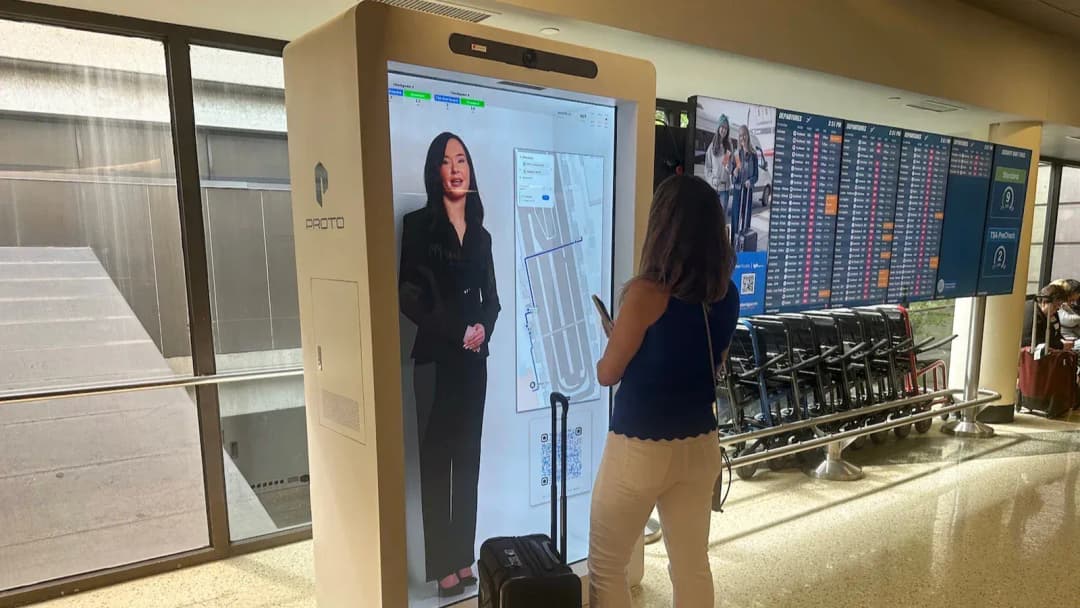
Boston Logan International Airport has deployed Amelia, a human-sized AI avatar, to help travelers navigate more quickly and personally. The experience shows that display technologies create value when they address a real customer-journey problem.
In places such as airports, exhibitions, and shopping centers, customers are rarely looking for an advertisement alone. They want to find their way quickly, get answers to their questions, and reach their destination without friction. This need has helped bring interactive displays, AI avatars, and hologram-like experiences into public spaces.
One notable example is Amelia at Boston Logan International Airport: a human-sized AI avatar designed to guide travelers. The project is more than a technology showcase. It demonstrates how digital signage, customer service, location data, and natural-language interaction can work together—an approach that offers important lessons for Iranian brands and event organizers as well.
What Does Amelia Do at Boston Airport?
Boston Logan Airport provides direct access to more than 150 domestic and international destinations and is home to more than 40 airlines. In such an environment, finding a gate, baggage-claim area, or lounge can be difficult for travelers, particularly during busy periods.
Amelia is positioned across all airport terminals as a wayfinding guide. Travelers can speak with it in natural language and ask about gate directions, baggage-claim locations, restaurants, shops, and lounges. The avatar also provides step-by-step directions, a live map, and updated information about TSA security-screening wait times.
This is not simply a display intended to be watched. Amelia includes an integrated touchscreen, allowing users to select their needs or type in any language. The system can also connect users with a human specialist, so when an automated response is not enough, the service journey can continue with a real operator.
- Communication in up to 40 languages
- Route estimates based on the traveler’s actual starting point
- Access to airport data and TSA wait times
- Direct escalation to customer-service staff
- Standalone operation through an integrated touchscreen, with no external equipment required
The Project Is Part of a Broader Wave of Hologram Experiences
Amelia is not the first use of holographic displays in a transportation environment. In April, travelers arriving in Pittsburgh for the NFL Draft encountered life-sized holograms of members of the Pittsburgh Symphony Orchestra performing around the clock. The experience was presented on a display approximately seven feet tall and weighing 400 pounds, in the Airside Center at Pittsburgh International Airport.
In June, fans traveling to California to watch the United States play in the 2026 FIFA World Cup encountered two holographic ambassadors at San Francisco International Airport: Brandi Chastain, a two-time Olympic gold medalist and two-time FIFA Women’s World Cup champion, and Daniel Lurie, the mayor of San Francisco. The installations were located after the security checkpoint, in Terminal 2 opposite the Amex Lounge and in Terminal 3 near the E-gates food court.
The key difference between Amelia and these examples lies in the primary purpose of the experience. The Pittsburgh and San Francisco holograms were used mainly for welcoming visitors, entertainment, and creating memorable moments. Amelia, by contrast, directly addresses a service need. Both approaches are valuable in experience-led marketing, but their success metrics are different: one depends on attracting attention and strengthening brand recall, while the other focuses on reducing confusion and improving the customer journey.
Lesson One for Brands: Do Not Start with the Technology
The Boston project was developed in collaboration with the Massachusetts Department of Transportation, Proto Hologram, and Holomedia AI. Proto provides hologram and AI spatial-computing technology, while Holomedia AI works in holographic communications, spatial computing, and AI-powered passenger interaction. However, the project’s value lies not only in the technology used. It began with a clear question: how can traveler guidance be improved in a complex and stressful environment?
For an Iranian brand, this same logic should be applied before choosing a hologram, kiosk, or LED display. At an exhibition, the problem might be directing visitors to a stand, explaining a complex product quickly, or registering a consultation request. In a shopping center, the goal might be helping people find a store or receive a personalized recommendation. Without a clearly defined problem, technology becomes expensive décor that attracts attention but creates no obvious commercial value.
In Boston, each Amelia knows where it is installed and can calculate precise directions from a person’s actual starting point. The necessary data for approximately 400 searchable locations has been collected and synchronized, with a goal of expanding this to 1,000 points of interest. These details show that a seemingly simple experience depends on substantial work in information architecture, mapping, positioning, and data maintenance.
- Define the customer’s primary problem precisely.
- Collect and clean the required information before designing the experience.
- Build the path to human assistance into the project from the beginning.
- Measure success through indicators such as response time, request completion, and reduced confusion.
Applications for Exhibitions, Stand Design, and Digital Signage
At exhibitions, an intelligent avatar can serve as a receptionist, hall guide, or initial consultant. Visitors can enter a product name, industry, or need and be directed to relevant content, the appropriate stand, or the right specialist. This capability can be particularly valuable for brands with technical and multi-layered product portfolios, reducing the burden of repetitive explanations on the stand team.
However, the experience must be designed for the event environment. Exhibition visitors typically have limited time, so long conversations, complicated menus, or excessive visual effects may produce the opposite of the intended result. The display should be positioned where it is clearly visible and easy to access, and its initial message should be understandable within seconds.
The combination of technologies also matters. Digital signage can support general information, interactive kiosks can handle selection and request registration, and intelligent avatars can provide conversation and guidance. Augmented reality can be used to display layers of information over a product or structure, while virtual reality is better suited to simulating an environment, production line, or experience that is difficult to access physically. The choice among these options should be based on audience behavior and business objectives—not simply on technological appeal.
Trust, Accuracy, and Essential Boundaries
When AI interacts with the public, an incorrect answer is not merely a technical error. It can lead to confusion, dissatisfaction, or damage to brand credibility. For this reason, the system’s capabilities must be clearly defined: which questions it can answer, what data it can access, and when it must refer the user to a human employee.
In the Amelia experience, the avatar has been designed to appear human and trustworthy while using up-to-date location and operational information. But a realistic appearance alone does not create trust. Transparency about the system’s AI nature, privacy protection, data-access controls, and continuous response monitoring are integral parts of such a project.
For Iranian brands planning to use an avatar, hologram, or intelligent kiosk, a governance framework should be prepared before implementation. It should cover approved content, prohibited responses, data-retention and deletion procedures, network-failure scenarios, and human fallback processes. Technology should enhance the in-person experience, not replace employees in every situation.
- Assign a specific person to manage data accuracy and freshness.
- Refer sensitive or out-of-scope questions to a human specialist.
- Make sure users know they are interacting with an AI system.
- Provide fallback procedures for internet outages, display failures, and system limitations.
- Test real-world and high-frequency scenarios before public launch.
Practical Takeaways for Marketing Managers
Amelia at Boston Logan Airport shows that the future of experience-led services is not simply about installing an impressive display. A combination of a human-sized avatar, natural-language interaction, a live map, operational data, and access to human support becomes meaningful when it removes a real point of friction from the customer journey. The same principle can guide the design of stands, exhibitions, stores, and service centers in Iran.
Before commissioning a holographic or interactive solution, answer these five questions:
- At exactly which stage does the audience experience confusion or waste time?
- Do we have the data required to provide accurate, up-to-date answers?
- If the AI cannot help, who is responsible for continuing the service?
- Is the experience accessible to people with disabilities, users unfamiliar with technology, and speakers of different languages?
- Which measurable indicators will we use to evaluate the project’s success?
Inspired by: AI avatar concierge helping Boston airport travelers navigate flight journey
Need consultation for your next event?
FORESEEN specialists help you choose the best equipment and ideas for your brand and space.