When Audiences Do More Than Watch: Lessons from Coach and Spotify’s Experiential Tour
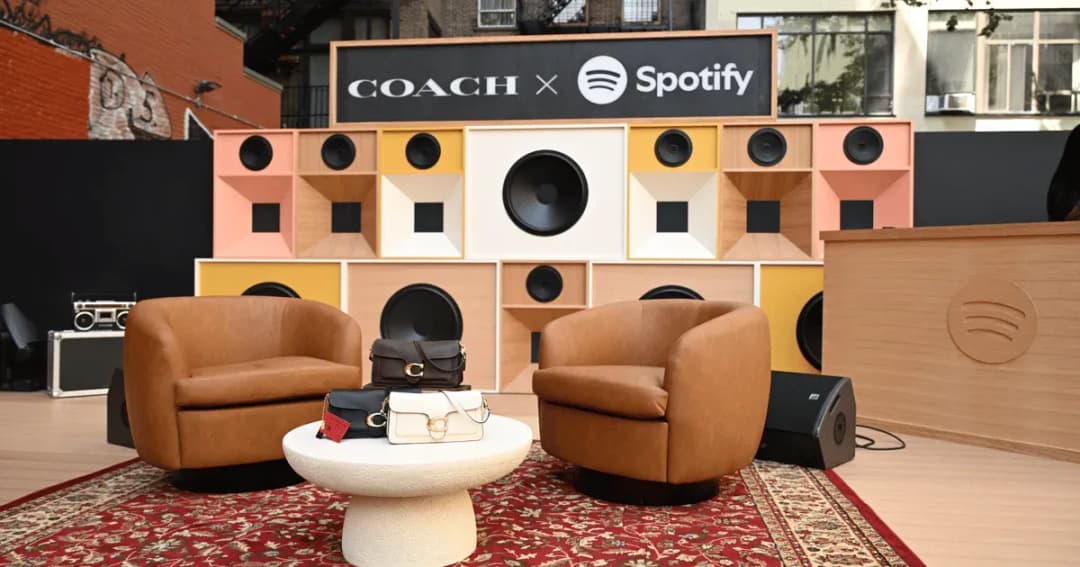
Coach and Spotify’s global Tabby tour shows how data, music, and participatory design can turn strangers into conversation partners. It offers Iranian brands and event organizers practical lessons in booth design, technology, and engagement measurement.
At many brand events, the primary goals are attracting visitors, encouraging photos, and distributing gifts. But an experience that motivates people to stay, participate, and talk to one another creates far greater value. Coach and Spotify’s global Tabby tour is a notable example of this approach—turning advertising into a personal, social, and shareable activity.
The project began on September 16 and is taking place at universities and cultural venues across the United States, the United Kingdom, Japan, and South Korea, with the tour scheduled to conclude in early 2027. A separate collaboration between Coach and QQ Music was also planned for a festival in Chengdu on November 6, followed by activations in Shenzhen and Nanjing. At the heart of the tour is a dedicated bus, live performances, conversations with artists, music discovery, and a range of physical and digital activities.
The key takeaway for Iranian marketing managers is that the success of an event like this does not necessarily come from the number of technologies used. The central questions are: What does the audience do at each point? What does each person discover about themselves? And why would they want to tell someone else about the experience?
From Personal Data to Genuine Conversation
One of the central elements of the Tabby tour is an experience called Courage Frequency. Using each person’s listening data on Spotify, it assigns them to one of six “courage signatures,” with each signature representing a different way of expressing courage through music. Along with the classification, visitors receive a personalized playlist that they can save or share with friends.
The value of this idea lies in more than personalization. At the New York event, people compared their signatures, which encouraged strangers to start conversations. In other words, data was not used solely for advertising targeting; it became a conversation starter.
For an Iranian brand, the same logic could be applied using simpler, more transparent data: travel preferences, visual taste, music preferences, cultural interests, or answers to a few short questions. However, information must be collected and used with the audience’s knowledge and consent. Personalization is most effective when it is genuinely interesting to the individual—not merely analytically valuable to the brand.
- Turn data into a tangible output, such as a card, signature, recommended playlist, or keepsake.
- The result should encourage comparison and conversation rather than simply appear on a screen.
- Collect only the information you need and be transparent about how it will be used.
Every Touchpoint Should Give People Something to Do
At the Tabby tour, visitors do not simply pass by visual elements. At the Ticket Booth, they can view special Tabby bags and customize their own accessory with Spotify codes linked to personalized playlists. At the Self-Expression Photo Booth, they can create a personalized concert ticket, while at Messages on the Board, they can write messages that travel with the bus to future stops.
This design clarifies the difference between “décor” and “experience.” Décor can be attractive, but an experience requires action. Even a small exhibition booth can be designed around the same principle: visitors can choose, create, record, compare, or take something away with them.
For Iranian event organizers—particularly at busy trade shows—this principle is highly relevant. If everything is limited to logo displays, advertising screens, or a photo backdrop, visitors have little reason to stay. An interactive kiosk, instant keepsake printing, short quiz, product selection, or personalized content creation can increase dwell time and improve the quality of engagement, provided the process is simple and quick.
- Define every activity with a verb: choose, create, discover, compare, or share.
- Long processes, unclear queues, and complicated forms reduce participation.
- A keepsake should be connected to the experience itself, not be a gift unrelated to the brand message.
When Brand Storytelling Comes to Life
The dedicated Coach and Spotify bus is more than a means of transportation; it is part of the campaign narrative. The bus is inspired by a vehicle featured in Coach’s fall campaign films, which star Elle Fanning and artists including PinkPantheress, SOYEON, Lilas, and Shan Yichun. In the story, Fanning drives a bus toward a music festival, while the passengers gradually connect through music and personal style.
In the physical activation, that story becomes a real environment. Visitors enter a space where Coach’s visual identity is combined with music discovery on Spotify. This gives both brands a clear role: Coach represents individual expression, while Spotify provides a platform for discovering music and connecting with artists and creators.
For Iranian brands, mobile structures, modular booths, and temporary spaces are valuable when they form part of the brand story. A truck or distinctive structure should not simply be large and attention-grabbing; it should take the audience from one chapter of the narrative to the next. Otherwise, production costs may rise without creating a lasting mental connection.
Technology Should Strengthen the Experience, Not Replace It
The campaign does not draw a hard boundary between physical and digital spaces. On Spotify, a dedicated hub titled Live Your Story gives audiences access to the Courage Frequency experience, the Track the Tour map, information about upcoming locations, artist lineups, and behind-the-scenes content. Content created at each stop also continues through Spotify and social media.
This approach shows why the digital layer should not be built as a promotional add-on after the event ends. From the beginning, it should be clear how each physical touchpoint continues on a mobile device, social platform, or landing page. For example, a QR code can connect visitors to a personal result, event map, playlist, visit time slot, or behind-the-scenes content—not merely to the website homepage.
In this context, holograms, augmented reality, virtual reality, advanced displays, and interactive kiosks can all be useful tools, but none of them creates an experience automatically. Even AI applications for content recommendations or customer service should address a genuine need. If technology increases waiting time or leaves visitors unsure what to do, visual appeal becomes a practical obstacle.
- Set a specific behavioral objective for every technology—for example, discovery, selection, creation, or sharing.
- Design the physical and digital experiences together rather than as two separate stages.
- Test the user journey with several real audience members before launch.
Global Execution, Local Identity
The Tabby tour is taking place in four countries, but not every stop is intended to be identical. The core experience remains consistent, while the artists, university communities, playlists, and atmosphere are localized to each city. In New York or Seoul, the bus should feel like part of that city’s music scene—not like an imported advertising package.
Artists including Tinashe, Rachel Chinouriri, Nxdia, Fousheé, and Alessi Rose appear at different stops. The focus on universities is also deliberate: these spaces are where people discover music, shape their personal style, and build new communities.
For multi-city events in Iran, the same model can be applied: keep the core message, visual identity, and participation mechanism consistent, while adapting the music, talent, local stories, and even the form of the giveaway to each city. Localization should not stop at changing a few images; it should demonstrate that the brand genuinely understands the cultural and social context of every destination.
Do Not Measure Success by Attendance Alone
The Tabby production team is not looking only at visitor numbers or the number of photos taken. One of the key measures is how long people stay in the space and how actively they participate. The goal is for visitors to engage with Coach and Spotify after entering—not simply take a photo and leave.
This approach is equally relevant to measuring branded events in Iran. Scan counts, activity completion rates, average dwell time, the number of saves or shares of personalized content, participation in conversations, and return rates can provide a more accurate picture of impact. However, every metric should connect to the campaign objective. For a sales event, qualified leads matter more than the number of photos; for a cultural event, the quality of participation and content creation may be more important.
Define the metrics before opening and build the tools for capturing them into the experience design. If measurement is considered only at the end, important data will already have been lost.
- Distinguish visitors from active participants.
- Measure dwell time alongside the quality of interaction.
- Assess audience-generated content based on its relevance to the brand message.
- After each stop, use data and feedback to improve the next one.
Practical Takeaways for Iranian Brands
The Coach and Spotify tour is a reminder that experiential marketing does not mean filling a space with expensive equipment. The starting point is a human insight: younger audiences want to spend less time behind screens and more time connecting with others in person. In this project, music becomes a bridge between individual identity and community, while personal data becomes a reason to start a conversation.
If you are planning a booth, exhibition, or city tour, begin by selecting one central action that people will genuinely want to take. Then build a personal outcome, a relevant keepsake, and a digital continuation around it. Add interactive technologies, displays, AI, augmented reality, or even holograms only when they make that journey simpler and more meaningful. Finally, keep the core identity consistent while adapting the experience to each city, community, and occasion. This approach increases the chance of turning a brief visit into a lasting relationship with the brand.
Inspired by: Inside Coach and Spotify's Global Tabby Tour
Need consultation for your next event?
FORESEEN specialists help you choose the best equipment and ideas for your brand and space.