How One Event Turned a Loyalty Program into an Unforgettable Experience
Southwest Airlines’ reveal of the future of Rapid Rewards shows that complex marketing messages are better understood and remembered when delivered through interactive, multisensory journeys. The example offers practical lessons for Iranian brands on booth design, technology, and the role of people at events.
At many product launches, audiences enter a venue, listen to a presentation, and leave with a collection of messages and slides. But when a product or service introduces several new features, a conventional presentation is rarely enough. Audiences need to see the benefits, interact with them, ask questions, and even experience part of the offering for themselves.
On October 15, 2026, Southwest Airlines took a different approach in Dallas to introduce the future of its Rapid Rewards loyalty program. Instead of simply explaining every change, the company guided guests through a series of interactive experiences covering everything from new loyalty tiers to international travel, faster Wi-Fi, and previews of future airport lounges.
Held at On The Levee, the event was designed for media, influencers, and social partners. The result was a notable example of how, in experiential marketing, “showing” can be more powerful than “telling”—provided every element is part of a cohesive narrative.
From a Press Launch to a Journey of Discovery
The Infinite Agency was responsible for the creative design of the one-day program. It began with a presentation by Southwest CEO Bob Jordan and other company executives. Behind eight-foot illuminated walls, the interactive part of the program remained hidden until the presentation ended. Then, one panel moved aside to reveal the “More Rewards Journey” to guests.
This simple decision gave the event a theatrical structure: first, the key information was presented; then, the audience had the opportunity to discover each message at a separate point along the journey. Rather than relying on one grand moment, the design team created a series of touchpoints—a kind of controlled maze in which each turn introduced another part of the loyalty program.
For Iranian marketing managers, this model is a reminder that an exhibition or event should not be limited to banners, catalogs, and screens. If a product has several benefits or serves different audience groups, the experience can be divided into multiple stations, with one question, one interaction, and one core message defined for each station.
- Design a clear route for audience movement, from entry to exit.
- Assign only one core message to each touchpoint.
- At the end of the journey, provide an opportunity to receive information, capture leads, or speak with an expert.
When Visuals Replace Lengthy Explanations
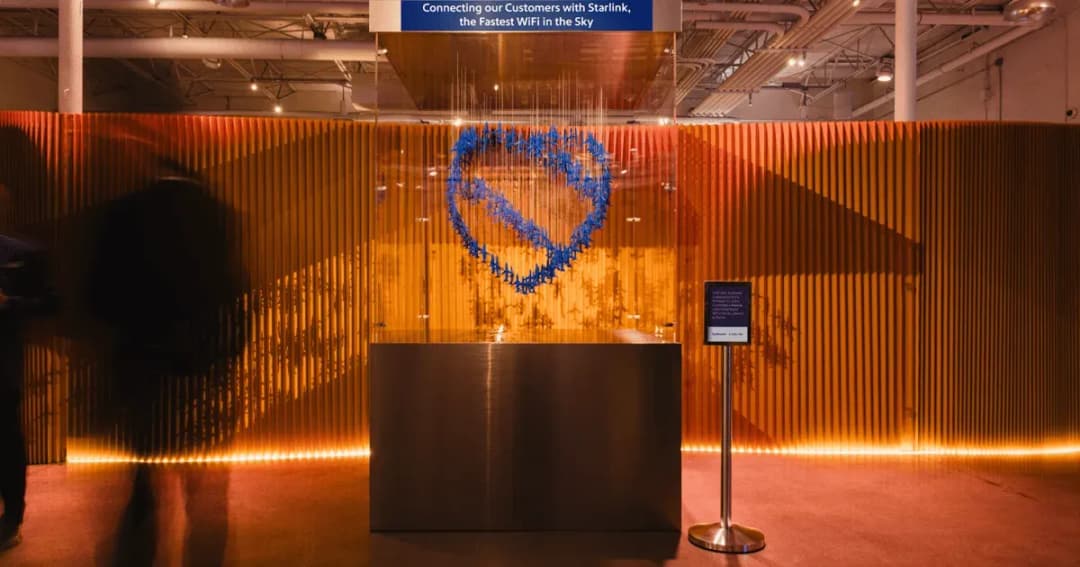
One of the event’s most striking elements was an anamorphic installation created in collaboration with Michael Murphy of Perceptual Art. The structure consisted of hundreds of airplane forms and displayed two different images depending on where the viewer stood: Southwest’s iconic heart from one angle and a Wi-Fi symbol from another.
Without requiring a lengthy technical explanation, the installation communicated the company’s plan to offer faster Wi-Fi across its fleet in 2027. The important factor was not the technology itself, but the relationship between the form, the audience’s movement, and the brand message. As viewers changed position, they discovered the meaning for themselves—and that participation made the message more likely to stick.
Iranian brands can apply the same logic to booth design. A 3D display, hologram, or multifaceted structure is valuable when it tells part of the product story, rather than serving merely as decoration or a visual attraction. Before selecting a technology, clarify what the audience should understand or experience.
- Do not separate technology from the message; every visual element should have a clear communication role.
- Design for audience movement or changes in viewing angle.
- Use 3D effects to simplify a concept, not to make it more complicated.
Engaging Multiple Senses to Create a Memory
Another part of the program featured a fragrance bar offering scents inspired by various destinations. This area was designed to explain new international travel opportunities available through Southwest’s loyalty partners. Guests could take small room-fragrance sprays with them, and a total of 165 bottles were distributed.
The program also included a live engraving station. Here, 200 pairs of champagne flutes were personalized by hand to highlight the broader benefits of Companion Pass through Milestone Rewards and Platinum status. The gift was therefore more than a generic keepsake; it was directly connected to one of the loyalty program’s key messages.
These experiences show how engaging multiple senses can make an abstract concept—such as “travel” or an “exclusive benefit”—more tangible. For Iranian brands, depending on the industry, this idea could translate into product sampling, ambient sound, material textures, personalized gifts, or the design of a short ritual at the booth. The essential point is that the sensory element must align with the brand identity and campaign objective.
- Connect every sensory experience to a specific commercial message.
- Personalize gifts so they become part of the experience rather than promotional merchandise.
- Plan each station’s capacity and volume from the outset, based on the program’s timing and number of guests.
Interactive Technology: From Virtual Reality to Smart Signage
The event featured a seven-panel lenticular display introducing the Rapid Rewards program’s new Silver, Gold, and Platinum tiers. Guests could also use virtual reality to preview sections of Southwest’s future airport lounges—spaces that were not yet ready for public visits in their complete form.
This example shows that virtual reality is most useful when the product or environment is not yet available, or when a real-life experience would be costly or difficult to deliver. In Iran, the technology can be used to introduce construction projects, travel experiences, interior designs, vehicles, industrial training programs, or factory tours.
Alongside VR, digital signage and interactive kiosks can display information based on each user’s choices. However, screens should not replace human guidance. At the Southwest event, subject-matter experts stood beside each activation to answer questions and connect the entertaining elements to the educational objective.
For interactive experiences in Iran, issues such as the Persian language, internet speed, accessibility for people with disabilities, technical support, and user consent should be considered from the design stage. A beautiful but slow or unstable kiosk can have a more negative impact than a simple, seamless tool.
- Prepare an offline alternative for interactive technologies.
- Keep the user journey short and easy to understand.
- Place an expert or facilitator beside the technology so questions do not go unanswered.
Balancing a Premium Experience with Precise Education
The program’s main challenge was to communicate several different messages without undermining the event’s premium and entertaining atmosphere. Guests needed to understand the changes to Rapid Rewards while also forming an emotional connection with Southwest’s new offerings. For this reason, every installation or activity served both a narrative role and an educational purpose.
This is particularly important for brands with complex, subscription-based, or tiered products. In such cases, striking décor alone is not enough. If audiences leave without understanding what has changed, what benefit it offers them, and what they should do next, the experience has become disconnected from its marketing objective.
The Southwest team also planned for different groups: a morning program for media and an afternoon experience for social partners and influencers. More than 200 people attended across the two sessions and, according to the organizers, the event generated approximately 3 million earned impressions. These figures alone do not define success; real value emerges when the audience receives the message correctly and talks about it afterward.
- Finalize the three core messages with all teams before execution.
- Prepare an appropriate journey or explanation for media, customers, business partners, and influencers.
- Measure success using a combination of attendance, engagement, lead quality, message comprehension, and media coverage.
Practical Takeaways for Designing Events in Iran
The Southwest event offers a clear lesson: a successful experience is not created by simply assembling attractive technologies. It is created by turning a complex message into a series of discoverable moments. The anamorphic structure, fragrance bar, engraved gift, virtual reality experience, and experts present in the space each formed part of one unified journey.
To apply this approach in practice, first define the business objective and core message. Then decide what the audience should see, touch, choose, or take away. Next, build the touchpoints with the appropriate tools—from a creative structure to an interactive kiosk or digital signage—and maintain human support and opportunities for feedback throughout the process.
When journey design, content production, and technology execution require greater coordination, specialized experience and exhibition companies such as FORESEEN can help turn an idea into an executable environment. However, even the strongest execution must begin with a clear strategy. Ultimately, the audience should not merely say, “The event was interesting.” They should understand what the brand is offering and why that offer matters to them.
- Turn the objective into a simple, easy-to-follow narrative.
- Link every technology to a message and an expected audience behavior.
- After the event, evaluate and document message comprehension and interaction quality.
Inspired by: Inside Southwest Airlines' Immersive Rapid Rewards Launch Event
Need consultation for your next event?
FORESEEN specialists help you choose the best equipment and ideas for your brand and space.