From Idea to Experience: Lessons from Building Tailscale’s First Customer Conference
Tailscale launched its first customer event without an event brand, an archive of visual content, or a dedicated agency—and reached a one-day experience for 300 people in 14 months. Its journey shows how clear goals, experience design, and cross-functional collaboration can create a meaningful event.
From the outside, creating a flagship customer event may look like a matter of choosing a venue, designing booths, and coordinating speakers. In practice, it is much closer to building a brand product. That product needs an identity, must create value for its audience, and should remain present in people’s minds and behavior after the event ends.
The experience of software company Tailscale is a notable example of this approach. The company began considering a customer conference when it had no event brand, no images from previous programs, and no budget to work with a full-service agency. Nevertheless, 14 months later, it held its first one-day event, TailscaleUp, at San Francisco’s SFJAZZ Center for 300 attendees.
The relevance of this example for Iranian brands lies not only in its scale or technology focus. Its real value is in the decisions that can be adapted for exhibitions, industry events, product launches, and experience-led programs in Iran—from defining objectives and building a team to making smart use of modern displays, digital content, and interactive tools.
Turn the Event into a Living Translation of the Brand
Tailscale did not view its event as merely a collection of talks. TailscaleUp was intended to be a tangible expression of the brand: technical, community-oriented, and deliberate. That is why the program combined educational sessions, hands-on workshops, live demos, networking, and gamification. Even the evening party, titled TailscaleUp After Dark, continued the brand story through a visual identity inspired by “dark mode.”
This perspective raises an important question for an Iranian marketing manager: if the audience spends only one day with our brand, what should they remember at the end of it? The answer might be trust, innovation, expertise, accessibility, or a sense of belonging to a professional community. The venue design, arrival journey, stage content, staff interactions, and even the event gift should all serve that same quality.
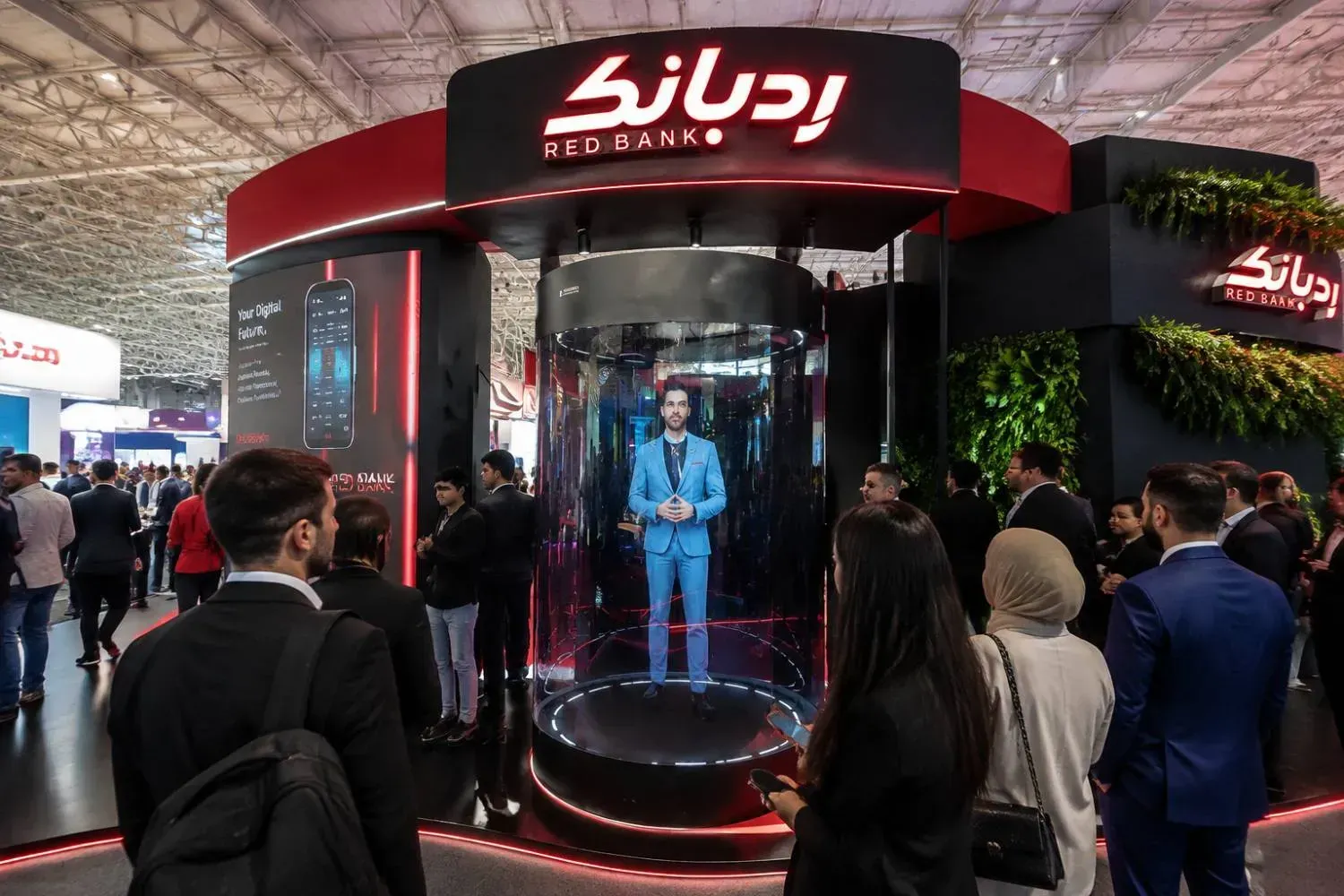
From this perspective, holograms, large displays, augmented reality, and interactive kiosks are not the objective; they are tools. If a modern display is used only to attract attention without connecting to the brand narrative or the audience’s needs, it creates an expense separate from the experience. By contrast, a simple but relevant demo can have a greater impact than flashy technology.
- Define a clear promise for the audience experience—for example, “By the end of the event, every participant should be better equipped to solve a real problem.”
- Align every touchpoint with that promise: the invitation, registration, entrance area, stage content, hospitality, and post-event follow-up.
- Before choosing a technology, determine what behavior or emotion you want to create in the audience.
When You Do Not Have an Agency, Build an Agile Team
Tailscale could not allocate the budget for a full-service agency. Hillary Foster, the company’s events manager, chose not to stop the project. Instead, she built a distributed but specialized team of independent professionals and collaborators found through professional networks. During execution, responsibilities such as production, stage design, animation, photography, catering, venue management, gifts, and interactive activities were divided among different suppliers.
This model will be familiar to many Iranian brands, particularly when the event budget is limited or the company has little experience producing large-scale programs. Its strength is flexibility and the ability to select a specialist for each area; its weakness is the risk of misalignment. Therefore, not having an agency must not mean operating without integrated management.
One person or internal team should own the overall experience and control the schedule, budget, responsibilities, approvals, and risks. Separate supplier contracts should also connect to a single brief—a concise document that clarifies the event objective, audience, visual tone, expected deliverables, and operational constraints.
- Identify the project owner and final decision-maker from the outset.
- For every supplier, define the deliverable, approval deadline, and coordination lead.
- Do not overlook hidden costs in the budget, including transportation, technical testing, content production, and post-event support.
Program Architecture: From the Main Stage to Real Conversation
Three elements formed the backbone of TailscaleUp: a main stage for the keynote, a room for hands-on workshops, and a demo station in the lobby. The demo area was designed to serve two purposes: enabling participants to speak with Tailscale specialists and giving them a place to get answers. This layout created a healthy balance between one-way content, practical learning, and human connection.
For exhibitions and product events in Iran, this combination can take many forms. The main stage is useful for building credibility and delivering a key message; a workshop or experience lab turns the audience from listeners into participants; and a demo station or interactive kiosk enables short, focused conversations. In fields such as technology, banking, or industrial equipment, audiences are often more engaged when they can test their questions against a real product or scenario.
The Tailscale event also included a pre-conference social program. On August 25, approximately 50 to 60 members of the “homelab” community gathered, and some of them served as session presenters themselves. This decision turned the customer community from a passive audience into part of the program—an approach that can be highly valuable for brands with professional users, customer communities, or representative networks.
- Define the audience’s role in each part of the program: listener, tester, collaborator, or content creator.
- Alongside formal presentations, provide sufficient time and space for Q&A and direct conversation.
- If you have an active user community, give its members the opportunity to share real experiences; this content is usually more credible than purely promotional messaging.
Extend the In-Person Experience with Digital Content
The TailscaleUp keynote was livestreamed and posted on YouTube. Other sessions and workshops were also recorded for gradual release. However, the company did not turn the entire program into a hybrid event, because it wanted the primary value to remain in the in-person, hands-on experience.
This distinction is important for event organizers. Digitalization does not necessarily mean putting everything online. You can record the parts that are suited to broader access, credibility-building, or lasting content, while keeping interactive elements for attendees on site. Demo videos, short interviews with specialists, answers to frequently asked questions, and virtual booth tours can extend an event’s life from one day to several weeks or months.
For an Iranian brand, this content can be used across social media, product pages, sales newsletters, and communications with prospective customers. Digital displays, smart signage, and interactive kiosks can also provide visitors with a fast, easy-to-understand version of the same content at the venue—provided that the interaction path and next action are completely clear.
- Before the event, determine which elements are suitable for livestreaming and which should be edited and released later.
- Assign a post-event use to every recorded piece of content, such as lead generation, customer education, or sales enablement.
- Connect information collected through kiosks or digital forms to the sales and customer-service follow-up process.
Small Details Create Lasting Memories
At TailscaleUp, gifts were part of the designed experience rather than items separate from the event. Tote bags were made from recycled materials, Fill it Forward water bottles were provided to attendees, and a station was created where participants could make keychains using branded, colorful keycaps. These were real keycaps that could be used on mechanical keyboards, giving the gift a direct connection to the interests of the technology community.
Cards or water bottles also allowed participants to choose from colored stickers. Hospitality was designed with creative stations as well, including a dessert station called “Every Day Is Cheat Day.” These details show that experience-led design does not necessarily require an expensive installation or complex technology. Personalization, usefulness, and alignment with the audience’s culture can sometimes have a greater impact.
At Iranian events, instead of offering a generic, predictable gift, organizers can design a short activity connected to the industry or audience community: product personalization, creating a useful keepsake, taking a photo in a creative space, or playing an interactive game that leads back to the brand message. If you use augmented reality or artificial intelligence, the output should ideally be something the audience can save, share, or genuinely use—not merely an exciting moment.
- Choose gifts based on the audience’s lifestyle and interests, not only the corporate color palette.
- Design a short activity in which participants make, choose, or change something.
- Take sustainability seriously in the selection of items, water and hospitality management, and reduction of single-use materials.
Measure Success After the Event
Foster emphasized that organizers should establish clear objectives before work begins. Tailscale defined five trackable goals and secured executive approval at the same time as the budget. The company was still analyzing return on investment and was examining metrics such as attendance and the types of new or expanded contracts generated by the event.
This approach is essential for avoiding vague judgments. “It was a good event” is not a metric. From the outset, a marketing manager should know how success will be measured: the number of key customers attending, sales meetings, demo requests, workshop participation, satisfaction, user-generated content, or revenue from existing customers.
Internal employees also need to understand why the event matters. Foster gave presentations during company-wide meetings to explain the program’s importance and expectations, helping different departments get involved. When sales, customer service, product, and public relations view the event as part of the business strategy, both the quality of the experience and lead follow-up improve.
Future development should also be guided by the data. Tailscale had raised the possibility of hosting roadshow events because it has a global community, but the format for the following year was not yet confirmed. This flexibility is better than automatically repeating a format that may no longer match the audience’s needs.
- Set five to seven primary metrics before approving the budget.
- Plan lead and contract follow-up around defined timeframes, such as immediately after the event and during the following months.
- Bring together feedback from attendees, employees, sponsors, and sales, then refine the next format accordingly.
Practical Conclusion
The TailscaleUp experience shows that a flagship event does not begin with a large budget; it begins with a clearly defined value proposition. In 14 months, without a full-service agency or an event track record, Tailscale created a program that brought together a main stage, practical education, demos, a user community, publishable content, and a social experience.
To apply this approach in Iran, start by writing one measurable objective, then design an experience that remains faithful to the brand identity. Build an agile team with a clearly designated owner, define the role of every touchpoint, use technology only where it improves interaction, and establish the post-event follow-up path from the beginning. Finally, do not measure success solely by how memorable the event was; examine how the experience changed the customer relationship, sales opportunities, and brand value.
If you need an integrated framework for designing an exhibition experience, digital signage, or an interactive kiosk, the central principle is coordination among space, technology, content, and business objectives. That principle should be clear before selecting any tool or supplier.
Inspired by: How Tailscale Built a Customer Conference From Scratch
Need consultation for your next event?
FORESEEN specialists help you choose the best equipment and ideas for your brand and space.